From Naspers to Prosus: The Tencent Investment and Its Legacy
Trace Naspers’s Tencent investment, the 2019 Prosus listing and restructuring. Learn how economic ownership differs from voting rights and management control.
Three companies, not three names for one business
Naspers began as a Cape Town publishing company in 1915. Its later investment in Tencent connected that South African business with China’s internet economy. The creation of Prosus added another listed company to the relationship. [1][3]
These companies have different identities. Naspers is the South African parent, Prosus houses international internet interests, and Tencent is an investee rather than a wholly owned subsidiary. This distinction matters when reading their histories and ownership disclosures. [3][2]
The story also separates company building from founding. Koos Bekker became Naspers chief executive in 1997 and retired from that position on 31 March 2014. His leadership came long after the company’s establishment. [6][1]
An investment in an existing Chinese business
Tencent dates its establishment to 1998 and identifies Shenzhen, China, as its headquarters. Its own history therefore begins before the Naspers group’s investment. The South African investor did not create the company. [7][1]
Naspers’s 2004 regulatory filing records the Tencent acquisition in May 2001, through a group subsidiary. It records a cash purchase price of R266 million, including directly attributable acquisition costs. The filing separately records R8 million of subsequent funding. [1]
That distinction prevents later funding from being folded into the original purchase price without explanation. These are historical rand amounts from the filing. They are not a present valuation or a conversion using today’s exchange rate. [1]
The investment occurred during Bekker’s executive tenure. That timing establishes the leadership context, but it does not establish that one person alone negotiated or approved every decision. Corporate investment and personal ownership are different claims. [1][6]
Prosus created a separate listed route to the assets
Prosus was formed to hold Naspers’s international internet assets. Its primary listing on Euronext Amsterdam began on 11 September 2019. It also obtained a secondary listing on the Johannesburg Stock Exchange. [3][2]
The listing did not mark the start of Tencent or the original South African investment. It changed the listed structure around an existing collection of assets. Investors could now buy shares in Prosus as a separate issuer. [3][2]
The structure must be read from the top down. A Naspers shareholder owns shares in Naspers. A Prosus shareholder owns shares in Prosus. Neither description makes that investor a directly registered Tencent shareholder merely because Tencent sits within the investment portfolio. [2]
Prosus’s annual report describes Tencent as an associate in its investment accounting. This is a different category from a controlled subsidiary. It provides another reason not to describe Tencent as an operating division of Naspers. [2]
| Record | Role in the relationship | What not to confuse | Sources |
|---|---|---|---|
| Naspers | South African listed parent with voting control of Prosus. | Its economic interest is not the same as its voting percentage. | [2] |
| Prosus | Separately listed international internet group and Tencent investor. | Its September 2019 listing is not Tencent’s founding date. | [3] [2] |
| Tencent | Chinese technology business established in 1998 and treated as an associate. | An equity investment does not make it a wholly owned subsidiary. | [7] [2] |
Why the 2021 cross-holding is now history
The relationship became more complex after a voluntary exchange offer implemented on 16 August 2021. Prosus acquired an economic interest in Naspers while Naspers retained its interest in Prosus. The companies consequently held interests in each other. [3]
Prosus records the removal of this cross-holding in September 2023. The finalisation announcement scheduled the capitalisation issue and new share trading for 18 September. It also described the disposal of residual Naspers shares held by Prosus. [3][4]
The announcement explicitly separated economic participation from voting control. It provided for additional B shares with minimal economic value to preserve Naspers’s voting control. The mechanism helps explain why a single ownership percentage can mislead. [4]
An old diagram showing both companies owning each other is therefore not a reliable description of the present arrangement. The cross-holding belongs in the historical timeline. Current ownership claims require a later, dated disclosure. [3][5]
Economic ownership and voting power diverge
At 31 March 2026, Prosus reported that Naspers held a 43.42% economic interest and 75.66% of its voting rights. These figures describe different rights at the same reporting date. Neither figure should replace the other. [2]
The report says Naspers held all ordinary B shares. Each B share had one vote but only one-millionth of an N share’s distribution entitlement. The combination gives the B shares substantial voting importance despite limited economic participation. [2]
Economic participation concerns a shareholder’s financial entitlement. Voting rights concern decisions made through shareholder votes. The annual report says Naspers has significant control over Prosus management, director elections, shareholder approvals and significant corporate transactions. [2]
This control relationship does not make Naspers the daily operator of Tencent’s businesses. Prosus’s investment accounting still identifies Tencent as an associate. Readers should not carry the parent’s voting percentage across another company boundary. [2]
The Prosus share-count table was updated to 9 October 2026 when reviewed for this article. It reports different share classes and economic participation. This article retains the explicitly stated March percentages rather than presenting them as October figures. [5][2]
Share repurchases changed the investment again
On 27 June 2022, Prosus and Naspers announced an open-ended share-repurchase programme. Prosus describes regular sales of Tencent shares as its funding source. Its stated aim was to reduce the discount between share prices and underlying net asset value. [3]
The intended discount reduction is a management objective, not a guaranteed outcome. Selling an investment and repurchasing the holding company’s shares are separate transactions. One reduces an asset holding, while the other reduces the shares held outside the company. [3][2]
For the year ended 31 March 2026, Prosus reported Tencent share-sale proceeds of US$6.5 billion. Note 6(j) gives its closing Tencent stake as 22.66%. It says those proceeds fund the group’s share-repurchase programme. [2]
The same note explains that Tencent was also repurchasing its own shares. The stake percentage therefore reflected changes in both the shares held and the investee’s share count. A sale percentage alone does not describe the whole movement. [2]
This history connects capital allocation with corporate structure. The 2001 investment, the 2019 listing and later repurchases answer different questions about the group. None should be treated as a substitute for the others. [1][2]
Frequently asked questions
Did Koos Bekker found Naspers? No. Naspers was incorporated in 1915. Bekker became chief executive in 1997 and later became its chair on 17 April 2015. Naspers listed him as non-executive chair when checked on 17 October 2026. [1][6]
Does Naspers own all of Prosus? No. The annual report states a 43.42% economic interest at 31 March 2026, alongside 75.66% of voting rights. Voting control does not require complete economic ownership. [2]
Does Prosus own all of Tencent? No. Note 6(j) reports a 22.66% stake at 31 March 2026 and treats Tencent as an associate. This is a dated reporting figure, not a live shareholding estimate. [2]
Do Naspers and Prosus still have the 2021 cross-holding? Prosus records its removal in September 2023. Descriptions of that earlier arrangement should be labelled as historical, rather than copied into a current ownership summary. [3]
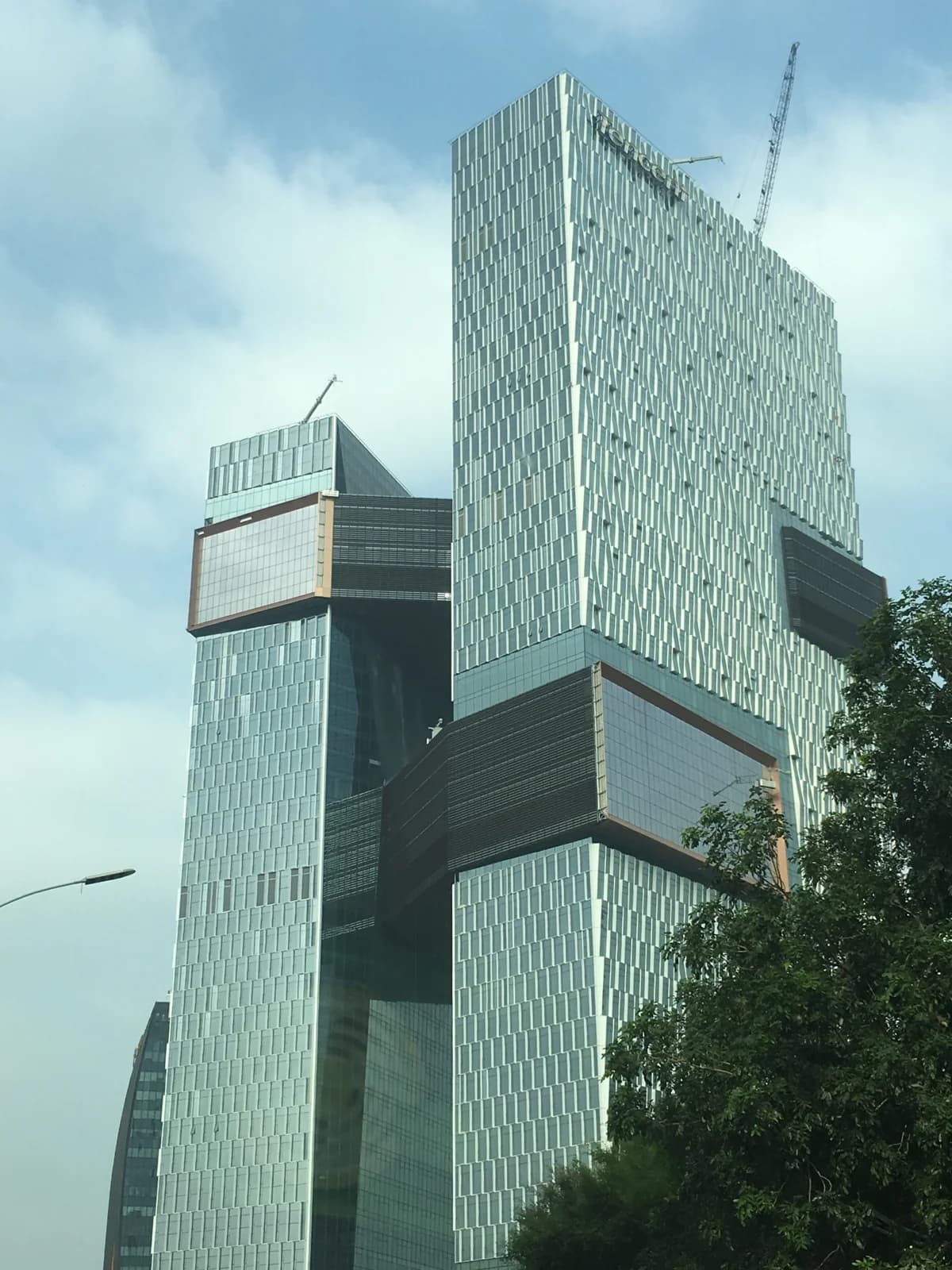
Is the photograph from the original investment? No. It shows Tencent Binhai Mansion in 2016, years after the 2001 transaction. It illustrates the investee’s physical presence and does not document the investment signing. [1][8]
Sources
- Naspers / US Securities and Exchange Commission, Naspers Form 20-F 2004: corporate history and May 2001 Tencent acquisition, pages 15 and 87, 2004-09-30. Original source. Accessed 2026-10-17. ↩
- Prosus, Annual Report 2026: governance page 41 and financial statements note 6(j). Original source. Accessed 2026-10-17. ↩
- Prosus, Group structure: listing, exchange offer, repurchases and removal of cross-holding. Original source. Accessed 2026-10-17. ↩
- Prosus, Finalisation announcement in respect of the Prosus capitalisation issue, 2023-09-04. Original source. Accessed 2026-10-17. ↩
- Prosus, Shares in issue: table updated 9 October 2026 and share-class economic rights. Original source. Accessed 2026-10-17. ↩
- Naspers, Leadership: Koos Bekker, chair appointment and executive tenure. Original source. Accessed 2026-10-17. ↩
- Tencent, Who we are: establishment, headquarters and business groups. Original source. Accessed 2026-10-17. ↩
- Wishva de Silva, Tencent Binhai Mansion: photograph dated 30 October 2016, CC BY-SA 4.0, 2016-10-30. Original source. Accessed 2026-10-17. ↩