March & March
March & March is a South African civic movement known for demonstrations demanding stronger immigration enforcement and the prioritisation of citizens in employment and services.
Published · Last reviewed
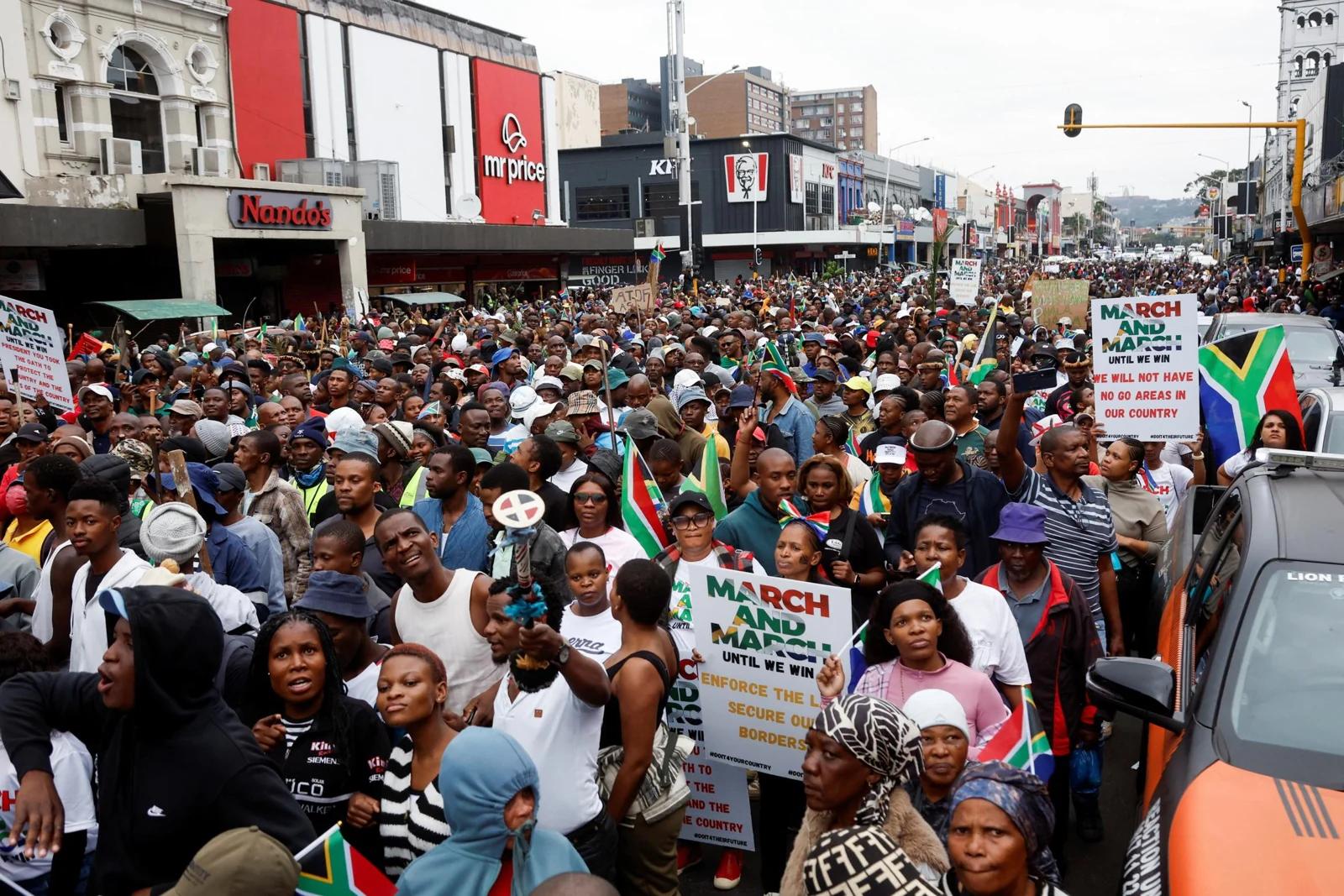
March & March describes itself as a citizen-led movement for immigration-law enforcement and border control. [2]
History
Berea Mail’s first-anniversary report implies a 2025 launch. The website footer gives March 2024. The accounts conflict, so this profile leaves the founding date unset. [3][2]
Leadership and organisational structure
Public prominence and formal corporate office are different categories. amaBhungane reported that the company associated with March & March was registered in August 2025 and identified Sanele and Nozibusiso Khambule as additional directors. This profile does not infer that every prominent marcher is a founder or company director. [4]
Ngizwe Mchunu and Phakelumthakathi appeared alongside the movement during 2026 mobilisation. Eyewitness News recorded Ndabandaba’s description of his role as support for Ngobese-Zuma. March & March later suspended its working relationship with Mchunu. Those relationships should be described with dates rather than as permanent leadership positions. [5][6]
Campaigns and public scrutiny
The 25 March 2026 Durban march proceeded from King Dinuzulu Park towards the city centre, with a memorandum handed to law-enforcement authorities. Berea Mail reported support from people associated with several political organisations. Their attendance is not proof that the movement is a branch of those parties. [3]
The movement became part of the wider mobilisation around 30 June 2026. The Human Rights Commission affirmed lawful protest while calling for peaceful conduct and protection of other people’s rights. It warned against intimidation, hate speech, violence and damage to property. [7]
March & March and amabutho
March & March is a contemporary movement. Its overlap with individual amabutho leaders does not make it the same organisation as the Zulu regiments. [8][2]
Frequently asked questions
Who founded March & March?
EWN identifies Jacinta Ngobese-Zuma as the movement’s founder. [1]
Key milestones
amaBhungane reported registration of the company associated with the movement. [4]
Berea Mail documented a Durban march described as the movement’s first anniversary. [3]
Ngobese-Zuma and Ndabandaba led the Durban demonstration. [5]
The movement suspended its working relationship with Ngizwe Mchunu. [6]
Founded / co-founded by
Related articles
Sources
- Eyewitness News, March and March will protest every Thursday, says Ngobese-Zuma, 2026-07-01. Original source. Accessed 2026-10-02. ↩
- March & March, About our movement: story and leadership. Original source. Accessed 2026-10-02. ↩
- Berea Mail, March and March marks one year with Durban protest, 2026-03-25. Original source. Accessed 2026-10-02. ↩
- amaBhungane, Analysis: March and March and the shadow of 2021, 2026-06-28. Original source. Accessed 2026-10-02. ↩
- Eyewitness News, Phakelumthakathi distances himself from violence during anti-illegal immigration protests, 2026-07-01. Original source. Accessed 2026-10-02. ↩
- Cape Times / IOL, Ngizwe Mchunu responds after March and March suspends its working relationship, 2026-07-28. Original source. Accessed 2026-10-02. ↩
- South African Human Rights Commission, Call for peace and adherence to the rule of law during the 30 June marches, 2026-06-29. Original source. Accessed 2026-10-02. ↩
- Ditsong Museums of South Africa, Amabutho akwaZulu: royal patronage since the pre-Shakan era, 2023-02-21. Original source. Accessed 2026-10-02. ↩