How Jacob Frankel’s Oats Business Became Tiger Brands
How Jacob Frankel’s oats business became Tiger Brands, how acquisitions changed the group, and how equity, voting and management control differ today.
A small milling business became a listed food group
Jacob Frankel established an oats business in Newtown, Johannesburg, during the 1920s. [2]
The enterprise developed into Tiger Oats and later into the listed company called Tiger Brands. [2][3]
Its history combines product creation, acquisitions, corporate restructuring and professional management. [2][3]
Those stages explain why founder, brand, shareholder and chief executive describe different forms of authority. [2][4][5]
Jacob Frankel started in Newtown
Tiger Brands records Jacob Frankel as the person who established the Newtown business in the 1920s. [2]
The record identifies an operating founder, not a later institutional investor or professional manager. [2]
Frankel’s business supplied the commercial base for the later Tiger Oats company. [2]
The surviving corporate sources do not provide his complete life dates, so this article does not infer them. [2]
The brand story began before the listed company
The 2012 integrated report dates the registration of the Tiger Brands logo to 1920. [2]
The current company history says Jungle Oats was created in 1920. [1]
The same 2012 report records the Jungle Oats launch in 1925. [2]
These records describe related brand milestones, but they do not use identical wording or dates. [1][2]
Incorporation and listing changed the ownership structure
Tiger Oats and National Milling Company Limited incorporated and listed on the JSE in 1944. [2]
The listing introduced public share ownership to a business with earlier founder and brand history. [2]
A public listing did not make every product brand a separate listed company. [2]
It created a listed corporate parent through which investors could hold economic and voting interests. [2][8]
Barlow Rand acquired majority control in 1982
Barlow Rand acquired a majority interest through CG Smith Limited in 1982. [2]
A majority equity position can supply corporate control without changing the identity of the original founder. [2]
CG Smith was later unbundled from Barlow Rand in 1993. [2]
That event changed the holding structure again before the next major acquisition phase. [2]
Imperial Cold Storage widened the group in 1998
Tiger Oats acquired ICS Holdings Limited in 1998. [2]
The report identifies ICS as the former Imperial Cold Storage and Supply Company. [2]
The transaction brought a wider food business into the Tiger Oats corporate structure. [2]
It was an acquisition by an existing listed group, not a new founding of Tiger Oats. [2]
The Tiger Brands name arrived in 2000
Tiger Oats changed its name to Tiger Brands in 2000. [2]
The broader name reflected a portfolio that extended beyond breakfast oats. [2][3]
The legal name changed, while Jungle Oats continued as a consumer brand. [1][2]
A company name, a product brand and a historical operating business therefore require separate records. [1][2]
Astral Foods left the group through an unbundling
Tiger Brands unbundled its animal feed and poultry operations into Astral Foods in 2001. [2]
Astral Foods then received its own JSE listing. [2][9]
Astral described that listing as beginning with a R332 million market capitalisation. [9]
The unbundling created a separately owned listed company rather than a Tiger Brands subsidiary. [2][9]
SPAR became independent in 2004
Tiger Brands unbundled and separately listed The SPAR Group in 2004. [2][11][10]
SPAR’s 2005 report dates the JSE listing to 18 October 2004. [11]
That report said SPAR had no controlling shareholder at 30 September 2005. [11]
The transaction separated ownership of SPAR from ownership of Tiger Brands. [2][11]
Adcock Ingram also became a separate listed company
Tiger Brands made Adcock Ingram a wholly owned subsidiary and delisted it in 2000. [2][12]
It unbundled and separately listed Adcock Ingram on 25 August 2008. [2][12]
The two events show a period of complete subsidiary ownership followed by corporate separation. [12]
They should not be collapsed into one continuous ownership statement. [2][12]
Acquisitions continued to reshape the portfolio
Tiger Brands acquired the Bromor Foods business in 2007. [2]
That transaction added brands including Oros, Energade and Rose’s. [2]
The company acquired Crosse & Blackwell in 2009 and other African businesses in later years. [2]
These purchases expanded the brand portfolio after the company adopted its current name. [2]
The current group still joins old and newer brands
Tiger Brands describes its primary business as food, beverages and essential home and personal care products. [3]
The 2025 report grouped operations into milling and baking, grains, culinary products, treats, beverages and home care. [3]
Some brands predate Frankel’s business, while others entered through later acquisitions. [1][2]
The group is therefore a corporate portfolio, not one brand with one continuous operating format. [1][3]
The 2025 shareholder register showed broad public ownership
Tiger Brands reported 174,871,708 issued shares at 26 September 2025. [4]
Public shareholders held 86.81% of issued capital on that date. [4]
Non-public holdings represented 13.19%, including empowerment holdings, treasury shares and company schemes. [4]
These percentages describe the listed parent and not ownership of each consumer brand. [4]
Treasury and empowerment holdings require separate labels
Treasury shares represented 6.18% of issued capital at 26 September 2025. [4]
Empowerment holdings represented 6.84% on the same date. [4]
Treasury shares are held within the company structure and are not an outside investor position. [4]
Empowerment holdings are a distinct disclosed category and should not be combined with management authority. [4][5]
Investment managers and beneficial owners are different
The Public Investment Corporation managed 15.99% of issued capital at 26 September 2025. [4]
The Government Employees Pension Fund held the largest disclosed beneficial interest at 16.74%. [4]
An investment manager administers assets, while a beneficial owner holds the underlying economic interest. [4]
Neither table identified one beneficial owner with more than half of issued capital. [4]
Ordinary shares carry voting rights
Tiger Brands says shareholders can vote in person or appoint a proxy. [8]
Voting power follows the company’s ordinary share and meeting rules, not the chief executive title. [8][5]
The disclosed ownership table did not show one sole beneficial holder with majority control. [4]
This conclusion is date-specific and can change when shareholdings change. [4]
Tjaart Kruger holds management authority
Tiger Brands appointed Tjaart Kruger as chief executive in November 2023. [5]
The company still identified him as chief executive in its 1 June 2026 interim results. [6]
Kruger manages the group under board oversight. He does not own it through his job title. [5][4]
Management control, voting rights and beneficial ownership are separate categories. [5][4]
The 2026 interim result showed the current operating scale
Tiger Brands reported revenue of R17.9 billion for the six months ended 31 March 2026. [6]
The company reported 2.6% volume growth and a 1.3% price decline for continuing operations. [6]
It also reported R1.6 billion of share buy-backs during the period. [6]
These figures describe current performance and capital allocation, not the company’s founding history. [6][2]
Old sites still carry the industrial history
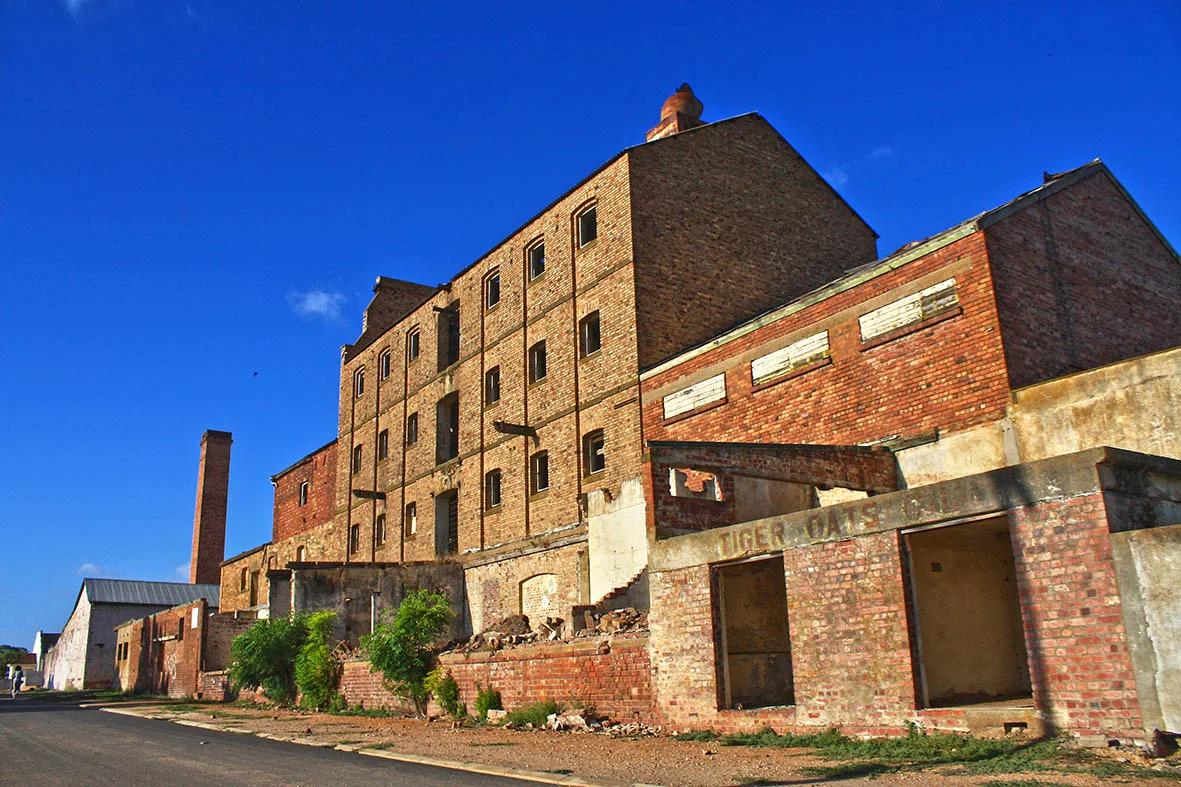
The main photograph shows the old Tiger Oats complex in Moorreesburg. [13]
Christopher Murphy photographed the complex on 26 September 2014. [13]
The image is licensed under Creative Commons Attribution-ShareAlike 3.0. [13]
It is an editorial record of industrial heritage and not a photograph of Jacob Frankel. [13][2]
Investment continues inside the current group
Tiger Brands announced a R200 million-plus transformation of its Paarl facility on 27 July 2026. [7]
The company said the facility was built in 1903 and now supports vinegar, chutney and jam production. [7]
The project shows how historical manufacturing assets can remain part of a modern operating network. [7]
It does not imply that the Paarl facility was Frankel’s original Newtown business. [7][2]
Frequently asked questions
Who founded Tiger Brands? Tiger Brands records Jacob Frankel as establishing the Newtown business during the 1920s. [2]
When did Tiger Oats list? Tiger Oats and National Milling incorporated and listed on the JSE in 1944. [2]
When did the Tiger Brands name start? Tiger Oats changed its name to Tiger Brands in 2000. [2]
Who owns Tiger Brands? It is publicly listed, and the 2025 register did not show one majority beneficial owner. [4]
Who leads Tiger Brands? Tjaart Kruger was chief executive when the 2026 interim results were published. [5][6]
Does Tiger Brands still own Astral, SPAR or Adcock? The company unbundled those businesses in 2001, 2004 and 2008. [2]
Sources
- Tiger Brands, Our history. Original source. Accessed 2026-11-12. ↩
- Tiger Brands, Integrated Report 2012, 2012-09-30. Original source. Accessed 2026-11-12. ↩
- Tiger Brands, Integrated Annual Report 2025, 2025-09-30. Original source. Accessed 2026-11-12. ↩
- Tiger Brands, Group annual financial statements 2025: shareholders information, 2025-09-30. Original source. Accessed 2026-11-12. ↩
- Tiger Brands, Leadership. Original source. Accessed 2026-11-12. ↩
- Tiger Brands, Unaudited group results for the six months ended 31 March 2026, 2026-06-01. Original source. Accessed 2026-11-12. ↩
- Tiger Brands, Tiger Brands transforms historic Paarl facility, 2026-07-27. Original source. Accessed 2026-11-12. ↩
- Tiger Brands, Shareholder frequently asked questions. Original source. Accessed 2026-11-12. ↩
- Astral Foods, Proudly celebrating 25 years on the JSE, 2026-04-09. Original source. Accessed 2026-11-12. ↩
- The SPAR Group, History. Original source. Accessed 2026-11-12. ↩
- The SPAR Group, Annual Report 2005, 2005-09-30. Original source. Accessed 2026-11-12. ↩
- Adcock Ingram, Integrated Report 2014, 2014-09-30. Original source. Accessed 2026-11-12. ↩
- Christopher Murphy / Wikimedia Commons, The old Tiger Oats complex, 2014-09-26. Original source. Accessed 2026-11-12. ↩